

St Mary’s Reading Rationale
Reading Curriculum
One of the most important jobs we undertake at St Mary’s is to teach children to become confident, independent readers with a love of reading. We prioritise reading across our curriculum from nursery up to year 6. We have carefully selected a range of texts which will expose the children with a rich reading experience. These texts have been chosen based on age, interests and current interests and books that have a range of protagonists and plots and themes. The texts allow them to see themselves reflected in literature as well as making children aware of the wider world beyond their immediate sphere. (See reading spine).
Reading in EYFS and KS1
At St. Mary’s, we follow the Read Write Inc. scheme to help our children to become fluid, confident readers and as a result become independent readers and writers. It is our intent to encourage children to fall in love with reading.
During their phonics lessons, the children are introduced to a new sound. This is reviewed in isolation and in the context of CVC and CVCC words. Children also revise previously taught sounds to ensure these become embedded in their long-term memory. Children are taught to segment and blend words through a variety of approaches, including guided, modelled through ‘Fred Talk’ and independent tasks using ‘Fred in your Head’ and a ‘Speedy Read’. Such strategies equip children with the skills needed to become confident, competent and independent readers.
Our phonics programme is tailored to meet the individual needs of our children and we promote the sentiment, “Keep up, not catch up”. Therefore, any gaps in the children’s phonics learning is identified and addressed through individual interventions to ensure their specific needs are met. Ultimately, supporting children to become independent and avid readers is the aim of our Read Write Inc. programme, as we believe reading is a vital skill which is fundamental to our children’s future happiness and functioning within our society.
Home reading in EYFS and KS1
Children are provided with books which closely correlate to their phonics knowledge. This enables the children to connect the sounds they are learning with mnemonic pictures, words with their meanings and stories with the sounds that they know. Children take home phonetically decodable books, which can be read independently by the children. This will instil confidence in our pupils and facilitate their fluency in reading.
Reading in KS2
Each week in Key Stage 2, we have 4 x 30 minute whole class reading sessions where children will either study the class novel or will explore a range of different texts.
Study of core text -During these sessions, we study the class novel in depth. Teachers will use high quality class reading books where the focus is on skills such as summarising and exploring development of plot,themes and characters. The children will be given the opportunity to discuss what they have read.
Additional texts – The children are given the opportunity to study a range of different texts to ensure they have a wide reading diet. The aim of these lessons is to develop language comprehension and reading fluency. A variety of fiction, non-fiction and poetry texts are accessible to ensure the reading objectives can be taught effectively. Children will be taught a range of skills such as summarising, retrieving, making inferences and predictions and exploring vocabulary and authorial intent. Children will record independent learning in a reading journal.
Children in KS2 who are still within the phonics programme will receive interventions for ‘speed up word reading.’
Home reading
Children in KS2 who have completed the phonics programme will choose a reading book which is broadly in line with their reading ability. Parents are encouraged to make a comment in their home diaries to keep school up to date on how children are getting on with their reading at home. We expect children to bring their reading books into school every day.
Reading for pleasure
In order to promote a love of reading, children are encouraged to use our school libraries which allows our children to be exposed to a range of texts. Throughout the year, we have a range of experiences to develop a love of reading e.g. book swap events, book fairs, world book day celebrations etc.
Assessment in reading
Children on the phonics programme will be assessed every half term. This will determine their sounds they need to learn, the colour of their phonics grouping and the decodable books that will be sent home. (See attached colour banding document)
In years 2-6 we use NFER reading assessments, 3 times a year and in KS2 children are assessed twice a year using NGRT (New Group Reading Test). Children who are performing significantly below age related expectations will be assessed using YARC (York Assessment for Reading of Comprehension). This will provide a diagnostic assessment so the correct targeted interventions can take place.
There are termly pupil progress meetings with the senior leadership team to discuss progress and to ensure the correct interventions are put in place.
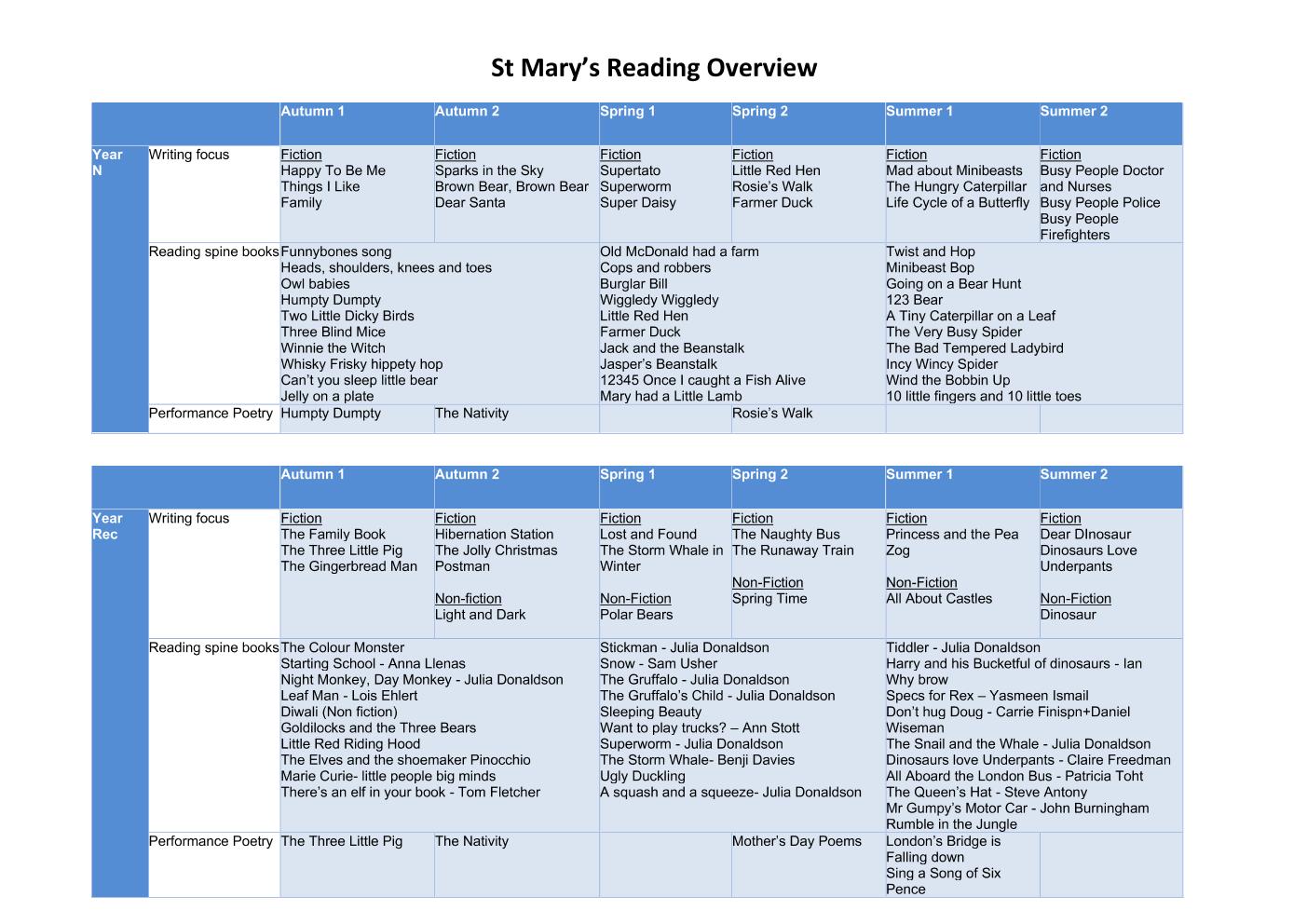
St Mary's Whole School Reading Spine
Please select the document below.


Read, Write Inc Phonics at St Mary's
Please use th elink to visit our Phonics Scheme page.

Improving Literacy in Key Stage 2
Preparing for Literacy - Early Years
Improving Literacy in Key Stage 1
Why Read to Your Child?
Please watch the video to learn more...

St Mary's Writing Intent
‘If you don’t see the book you want on the shelf…write it!’- Beverly Cleary
Here at St. Mary’s, we believe that every child has the potential to succeed. It is our job as teachers to harness that talent and provide engaging opportunities for our children to pen their own stories. Staff create an environment where writing is encouraged and celebrated. We do this through a bespoke, carefully structured, sequence of lessons. Our curriculum focuses on high quality texts which are used throughout the school and that build children’s knowledge and imaginations in a structured way.
Early writing begins long before children form sentences. In the Early Years, children explore mark-making, drawing, early letter formation, and simple transcription activities. These experiences help them understand that writing carries meaning and allow them to practise the foundational skills needed for later success.
In line with the Writing Framework’s guidance that handwriting and spelling (transcription) must be taught from Reception to build automaticity, we ensure children:
- Practise forming letters correctly
- Explore phoneme–grapheme correspondence
- Label pictures, copy words, and write simple sentences
- Orally rehearse sentences before writing
- Build adventurous vocabulary through picture books and talk-rich activities
As children move into KS1 and KS2, they begin to write with increasing independence. Our curriculum provides:
- Engaging texts to stimulate ideas
- Explicit teaching of vocabulary
- Retrieval grids that build on prior knowledge
- Direct teaching of writing skills and strategies
- Opportunities to practise transcription, including accurate spelling and fluent handwriting
- Regular oral rehearsal of sentences to support sentence fluency and reduce cognitive load
- Use of Writing Revolution strategies to strengthen sentence construction
- Dedicated time to plan, draft, edit, and publish writing
- Teacher modelling of the writing process, including live sentence construction
Our approach reflects the Writing Framework’s emphasis on teaching pupils how sentences work, supporting composition, and ensuring grammar is taught meaningfully within writing.
Across the school, we follow our sentence progression document, which ensures that children build a secure understanding of how sentences work. This aligns with the Writing Framework’s statement that “all writing is made up of sentences” and that sentence instruction is essential for developing control and meaning.
Children learn to:
- Construct simple, compound, and complex sentences
- Manipulate sentence structures for effect
- Apply grammar and punctuation within real writing
- Rehearse sentences orally before writing
- Edit and improve sentence clarity and accuracy
This structured progression ensures that pupils develop fluency, confidence, and control as writers.
Handwriting Rationale: Letter Join
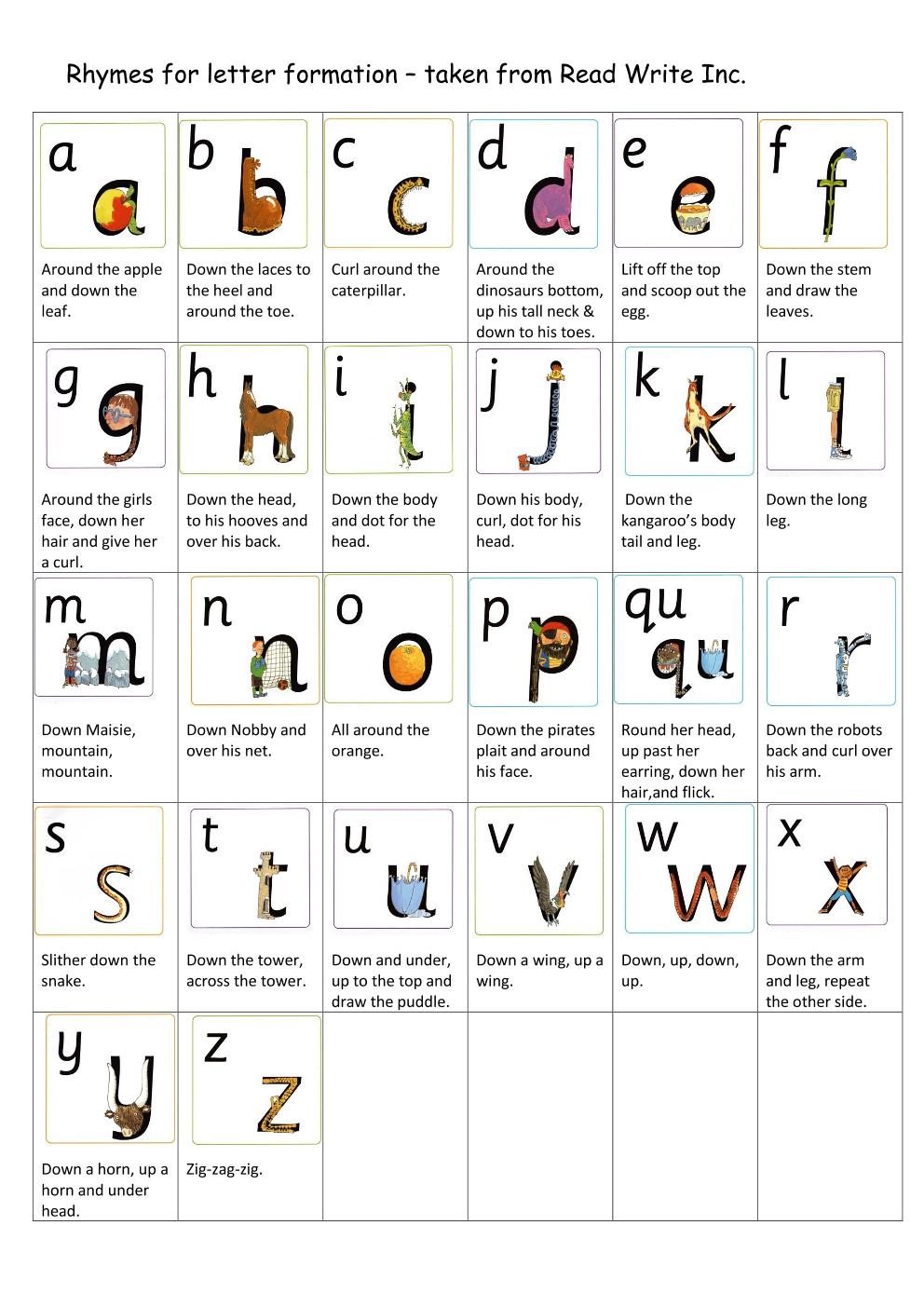
At St Mary’s RC Primary School, we believe that all children should be encouraged to take pride in the presentation of their handwriting. This is achieved through supporting the children to develop a legible, cursive, individual handwriting style by the time they move to secondary school. In the EYFS the first steps to achieve this are planned through a gross motor and fine motor timetable. The children in EYFS learn to form their letters using the Read Write Inc. designed by Ruth Miskin. In the Summer term the reception children are introduced to Letter-join. In Key Stage 1 and Key Stage 2 we use Letter-join’s on-line handwriting resource and progression as the basis of our handwriting policy as it covers all the requirements of the National Curriculum and builds fluency and stamina for writing.

Writing Curriculum Overview
Please select the document below.
Sentence Progression
Please select the document below.

|
Sentence Progression | [pdf 210KB] |

|

|
|
Letter Formation Rhymes | [pdf 2MB] |
|

English Resources
Please use the links below to access our learning resources.

