
2026-2027
The school’s catering service is provided by Taylor Shaw, caterer of choice for thousands of primary pupils across the UK.
Our menu is appetising, nutritious, balanced, and designed to encourage children to enjoy food, learn, play, and grow. Lunch is an integral part of the school day and something all children should look forward to. Taylor Shaw’s dedicated catering team ensures the dining hall is a welcoming and happy place for your child.
Our menus meet the Government’s School Food Standards and the bronze Food for Life standards.
- All items on our menu are freshly cooked by our catering team in your school kitchens to ensure we’re always offering fresh and nutritious food whilst minimising salt and sugar in recipes.
- No undesirable additives or artificial trans fats are used.
- Our menus provide for all dietary and cultural requirements
- Our suppliers adhere to all appropriate food safety standards
- Our catering team is supported with skills training in fresh produce
Taylor Shaw’s dedicated dietitians work with our Chef teams to ensure our menus are nutritionally sound, shaping recipes to ensure they meet the School Food Standards and standards set by Public Health England.
Please use this link to view our School Meal Policy.
Taylor Shaw Parents and Carers Leaflet
Please select the document below.

|
Information Leaflet for Parents & Guardians Eativerse TS (2) | [pdf 1MB] |

|

School Menus
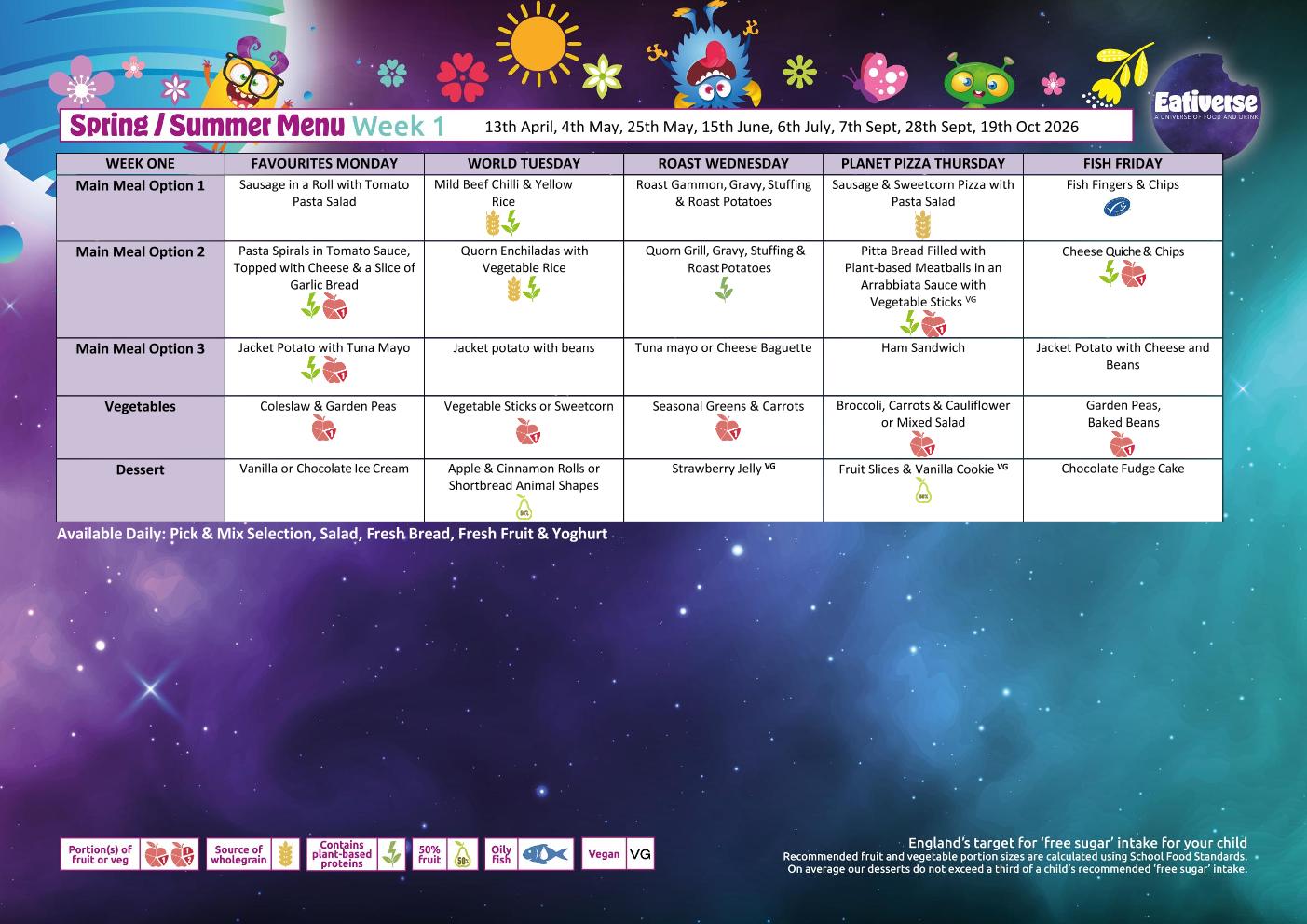
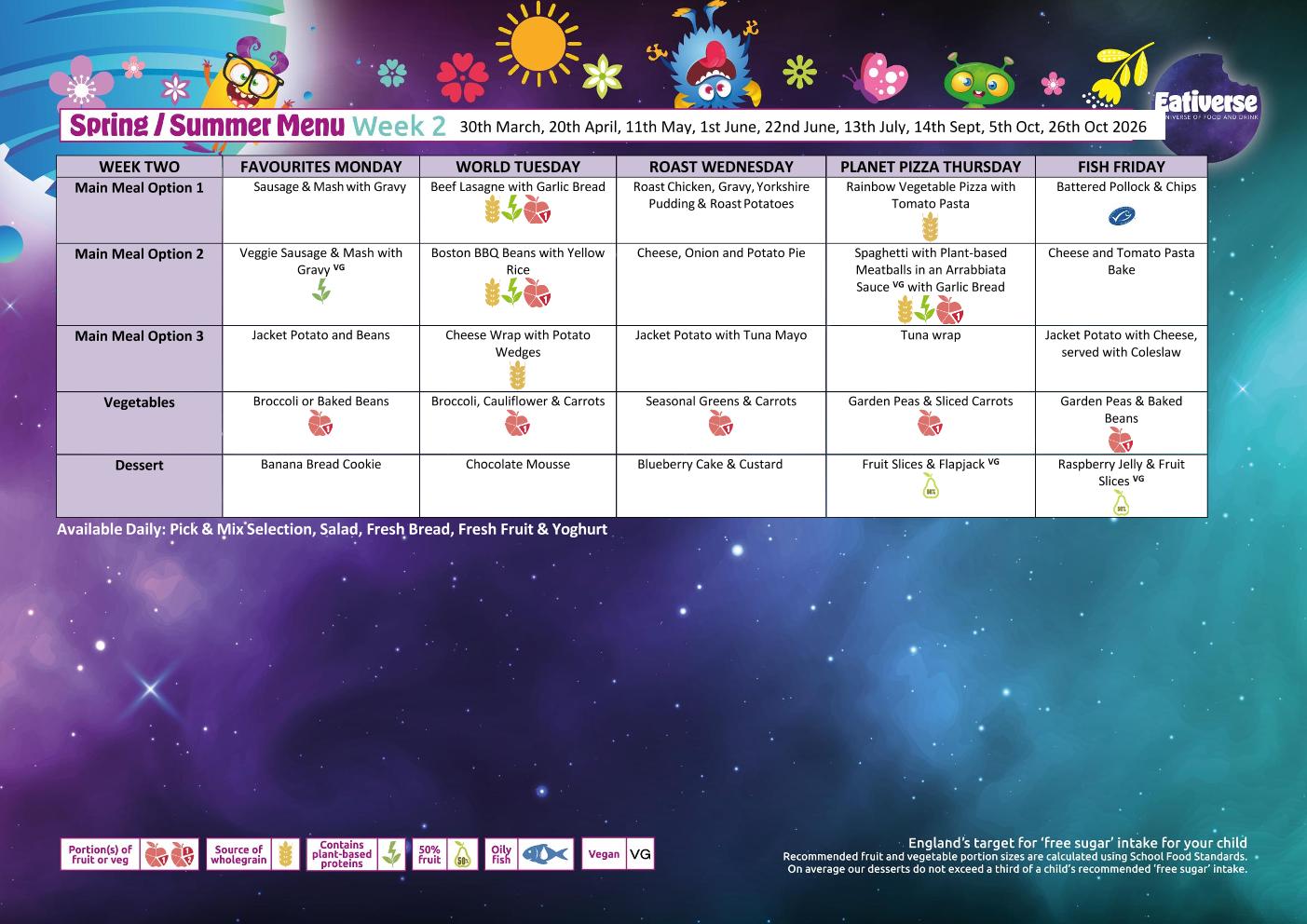
Our diverse menus include a wide variety of options to suit all tastes and are based on feedback from pupils, staff, the catering team, parents and guardians. We run a three-week menu cycle that changes twice a year.
|
|
St Marys Spring Summer 2026 Week 1 - Landscape - Eativerse | [pdf 474KB] |
|
|
|
St Marys Spring Summer 2026 Week 2 - Landscape - Eativerse | [pdf 454KB] |
|

|
|
St Marys Spring Summer 2026 Week 3 - Landscape - Eativerse | [pdf 455KB] |
|
Managing Allergies & Other Medical Diets
Your child's health and safety will always be of the utmost importance to us, and having accurate information about dietary needs and allergies is crucial for us to prepare and serve meals that meet their requirements
Taylor Shaw’s dietitians and catering team work together and follow a robust process, so you can feel reassured that whenever safely possible, an alternative menu will be provided. All the teams receive allergy training annually, and whenever there’s an update to allergen laws.
Our guide ‘Medical Diet Menus - A Guide for Parents, Guardians & Carers’ contains further information about the medical diet process and includes step by step instructions for you to record this information to ensure we are fully aware of any medical diet requirements.
About Our Food
About Our Food
Our menu is sourced responsibly and uses:
- Red Tractor-certified meat
- Marine Stewardship Council fish (MSC)
- Free-range eggs
- Local suppliers for bread, fruit & vegetables, and dairy products to reduce food miles
- Seasonal produce
Eat and Learn
We encourage pupils to learn about food through our food education program which includes fun-themed events, assemblies, and displays with messaging around health and wellbeing.
Eating a School Lunch is Better for Your Child
Did you know only 1% of packed lunches meet the nutritional standards that currently apply to school food? Here are five reasons school lunches are better:
- They can save time & money
- They’re nutritionally better than a packed lunch
- They promote a varied diet & encourage new tastes
- They support inclusivity, dining with friends
- They help academic attainment by being linked to improved concentration
Free School Meals for Key Stage 1 Children (Reception, Year 1 and Year 2)
All children in Reception, year 1 and year 2 in state-funded schools in England are eligible for free school meals.
Please inform school if you do not wish to receive this offer, otherwise your child will automatically be opted in to the free school meal.
The school meal service offers all primary and special schools with a multi choice menu.
School Meals for Key Stage 2 Children (Years 3, 4, 5, and 6)
The cost of a school meal is £3.00 per day (1st September 2026) or at no cost to those in receipt of a free meal entitlement.
The total weekly cost will be £15.00. Please pay for your dinners ahead of taking the meals.
KS2 Free School Meals
Reception Class, Year 1 or Year 2
Your child will be able to receive universal free school meals if they’re in a government-funded school and in reception class, year 1 or year 2.
Year 3 & above
Your child may be able to get free school meals if you receive any of the following:
- Income Support
- Income-based Jobseeker’s Allowance
- Income-related Employment and Support Allowance
- Support under Part VI of the Immigration and Asylum Act 1999
- The guaranteed element of Pension Credit
- Child Tax Credit (provided you’re not also entitled to Working Tax Credit and have an annual gross income of no more than £16,190)
- Working Tax Credit run-on - paid for 4 weeks after you stop qualifying for Working Tax Credit
- Universal Credit - if you apply on or after 1 April 2018 your household income must be less than £7,400 a year (after tax and not including any benefits you get)
Children who get paid these benefits directly, instead of through a parent or guardian, can also get free school meals.
Find further information and how to apply on your local authority’s website.
Please click on the link to access further information.
 |
Oldham Council Free School Meals |
Simply Veg - A Resource for Parents and Guardians
Simply Veg brings together a range of expert contributors including chef’s, nutritionists, psychologists and children’s entertainers to combine their skills to improve UK families’ diets. Simply Veg helps parents with the real challenges they face every day around the different aspects of feeding their children.
Support and resources focus on creating a positive food environment within the home, how to gently engage kids, understand their natural taste and sensory preferences, effective role modelling and what to do when your children just say “no”. In addition, Simply Veg provides advice aimed specifically at families with neurodiverse children developed with support from a specialist dietitian.
|
Simply Veg Website |

Simply Veg Resources for Parents and Carers
Please select the document below.
|
|
Simply Veg - A Resource for Parents and Guardians | [pdf 786KB] |
|
Change of Lunchtime Arrangement Form
If you would like to change your child’s lunchtime arrangements. Please complete the form below and return to the School Office or email the completed form to info@st-marys.oldham.sch.uk
You will need to give 2 weeks notice of the change. If changing to school meals, all meals should be paid via ParentPay, each week/month in advance.

|
Change of Lunchtime Arrangements | [docx 32KB] |
|
Healthy Packed Lunches
At least one portion of fruit and one portion of vegetables every day.
Meat, fish or other source of non-dairy protein (eg lentils, kidney beans, chickpeas, hummus, and falafel) every day.
Oily fish, such as salmon, at least once every three weeks.
A starchy food such as any type of bread, pasta, rice, couscous, noodles, potatoes or other type of cereals every day.
Dairy food such as milk, cheese, yoghurt, fromage frais or custard everyday.
Only water, still or sparkling, fruit juice, semi-skimmed or skimmed milk, yoghurt or milk drinks and smoothies.
Packed lunches should have limited items such as:
Crisps - Instead, include seeds, vegetables and fruit (with no added salt, sugar or fat). Savoury crackers or breadsticks served with fruit, vegetables or diary food are also a good choice.
Confectionary such as chocolate bars, chocolate-coated biscuits and sweets are not encouraged at school. Please only allow your child to eat cakes and biscuits as part of a balanced meal.
Meat products such as sausage rolls, individual pies, corned meat and sausages/chipolatas should only be included occasionally.
Please click on the link below for some ideas.
|
Change 4 Life Healthy Lunchbox Ideas |