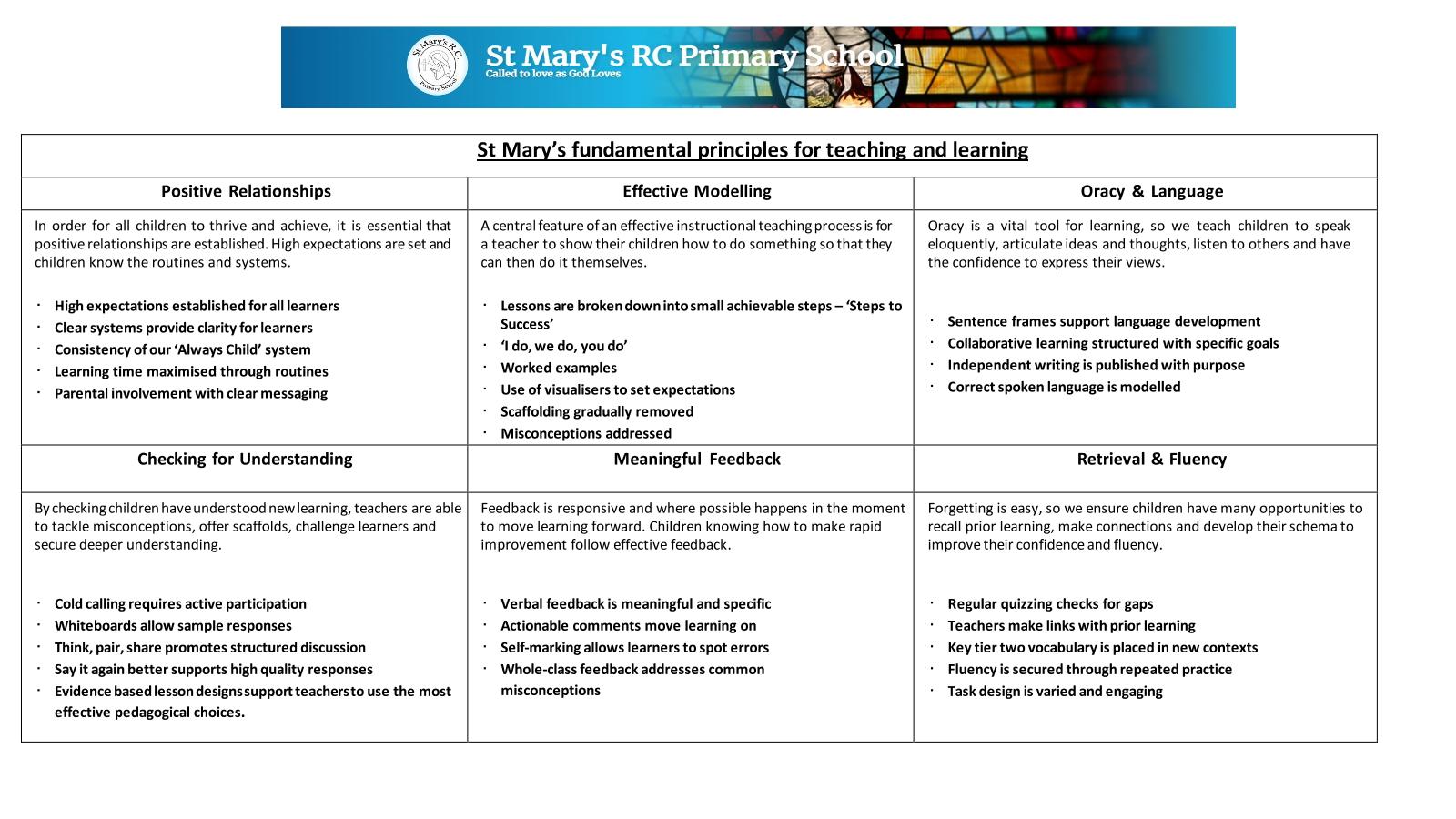
St Mary's Fundamental Principles for Teaching and Learning
Please select the document below.
Teacher Feedback to Improve Pupil Learning
All school leaders understand the importance of providing meaningful feedback. Done well, it supports pupil progress, building learning, addressing misunderstandings, and thereby closing the gap between where a pupil is and where the teacher wants them to be.
This guidance report aims to focus on what really matters: the principles of good feedback.
The guidance report is based on the best available international evidence, in addition to a review of current practice, and refined through consultation with teachers and other experts. We have used the findings of this report to inform the development of our Curriculum. Please use the link to find out more.

Metacognition and Self-regulated Learning
Evidence suggests the use of metacognitive strategies which get pupils to think about their own learning can be worth the equivalent of an additional +7 months progress when used well. This guidance report reviews the best available research to offer teachers and senior leaders practical advice on how to develop their pupils’ metacognitive skills and knowledge. We have used the findings of this report to inform the development of our Curriculum. Please use the link to find out more.
Annual Curriculum Planning Overviews
Please select from the links below to find out more about the curriculum taught at St Mary's school by year group and subject.
A Parent's Guide to the National Curriculum
English, Maths and Science remain very important and are considered the core subjects in both primary and secondary education. The National Curriculum sets out in some detail what must be taught in each of these subjects, and they will take up a substantial part of your child’s learning week. Alongside these are the familiar foundation subjects: Art, Computing, Design & Technology, Foreign Languages (age 7+ only), Geography, History, Music, and Physical Education. For these foundation subjects, the details in the curriculum are significantly briefer: schools have much more flexibility regarding what they cover in these subjects. Much of the publicity about the changes to the curriculum has focussed on ‘higher expectations’ in various subjects, and it is certainly the case that in some areas the content of the new primary curriculum is significantly more demanding than in the past. For example, in mathematics there is now much greater focus on the skills of arithmetic and also on working with fractions. In science, a new unit of work on evolution is introduced for Year 6; work which would have previously been studied in secondary school. In English lessons there will now be more attention paid to the study of grammar and spelling; an area which was far less notable in previous curricula.

|
Parents Complete Guide to the National Curriculum | [pdf 788KB] |

|

Click on the image above to view our Early Years curriculum page.

Click on the image above to view our Phonics curriculum page.

Click on the image above to view our English curriculum page.

Click on the image above to view our Maths curriculum page.

Click on the image above to view our Science curriculum page.

Click on the image above to view our History curriculum page.

Click on the image above to view our Geography curriculum page.

Click on the image above to view our Religious Education curriculum page.

Click on the image above to view our Computing curriculum page.

Click on the image above to view our Physical Education curriculum page.

Click on the image above to view our RSHE curriculum page.

Click on the image above to view our Music Provision page.

Click on the image above to view our Sacramental Programme page.

Click on the image above to view our British Values page.

Click on the image above to view our Art and Design page.

Click on the image above to view our Design Technology page.
Our Curriculum in Pictures
Please take a look at our class galleries to see the creative and exciting ways in which our curriculum is taught.
 |
Whole School Gallery of Events |
National Assessments